Uma Braun · 15 September 2026
Mycorrhizal Networks Reshaping Selective Cut Decisions on Private Forest Parcels
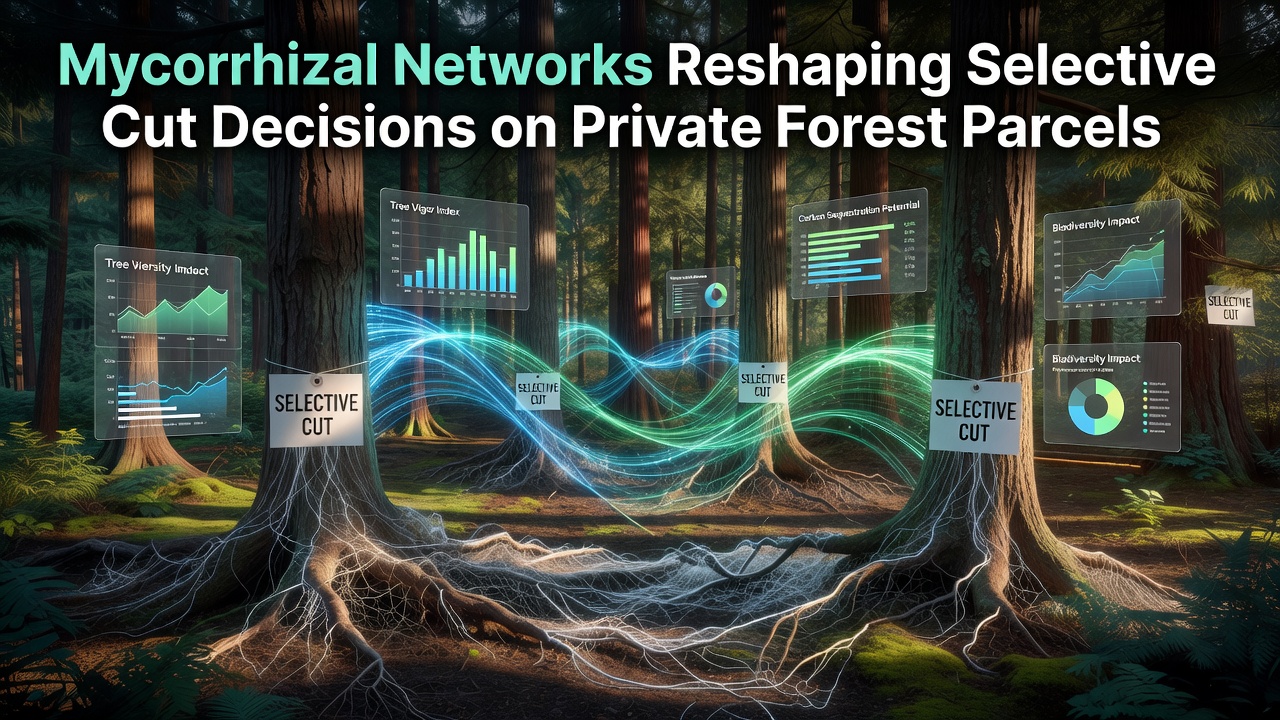
Private forest owners across North America and beyond have started adjusting selective cut strategies because mycorrhizal networks alter how trees share resources and recover after harvest, and data from multiple regions shows these underground connections influence stand resilience more than many traditional models predicted. Researchers discovered that fungal hyphae link individual trees, allowing carbon, nitrogen, and water transfers that support weaker or younger stems during periods of stress, which means removing certain mature trees can either strengthen or weaken the remaining network depending on species composition and spacing.
How Mycorrhizal Connections Function in Forest Stands
Common mycorrhizal networks form when fungal partners colonize root systems of multiple trees simultaneously, creating pathways that move nutrients across distances of several meters or more. Studies indicate that in mixed hardwood-conifer parcels this connectivity helps maintain phosphorus levels in shaded saplings while also buffering drought effects on canopy dominants, and observers note the effect becomes measurable within two to three growing seasons after a selective cut. Private landowners who map these networks before marking trees report fewer instances of post-harvest mortality compared with parcels harvested without such information, according to field records compiled by university extension programs.
Evidence from Recent Field Measurements
Measurements taken on parcels in the northeastern United States and parts of British Columbia reveal that Douglas-fir and eastern hemlock maintain especially dense hyphal links, whereas some oak species show more limited connectivity. When crews removed 25 to 30 percent of basal area in a single entry, plots that retained at least two connector trees per hectare retained higher soil moisture and greater understory diversity the following year. Data released in September 2026 from ongoing monitoring plots confirmed these patterns held across both privately owned woodlots and adjacent public research forests, prompting several state forestry agencies to update marking guidelines for private parcels.
Those guidelines now recommend that foresters identify potential “hub” trees—individuals with high mycorrhizal load—before finalizing cut lists, and they suggest leaving small clusters rather than isolated stems when possible. Because private owners often operate under different economic constraints than industrial managers, the shift requires new decision tools that integrate soil core sampling with conventional timber cruising.
Adjusting Selective Cut Protocols for Network Preservation
Foresters working with private clients have begun combining traditional volume tables with mycorrhizal density estimates derived from soil DNA assays or visual root inspections. One study conducted across 14 family-owned parcels in the Great Lakes region found that retaining 15 percent more canopy in network-dense zones reduced regeneration failure rates by nearly half over five years. Owners who adopted these combined protocols reported stable or slightly higher net returns because fewer replacement plantings were needed and residual stems grew faster after the cut.
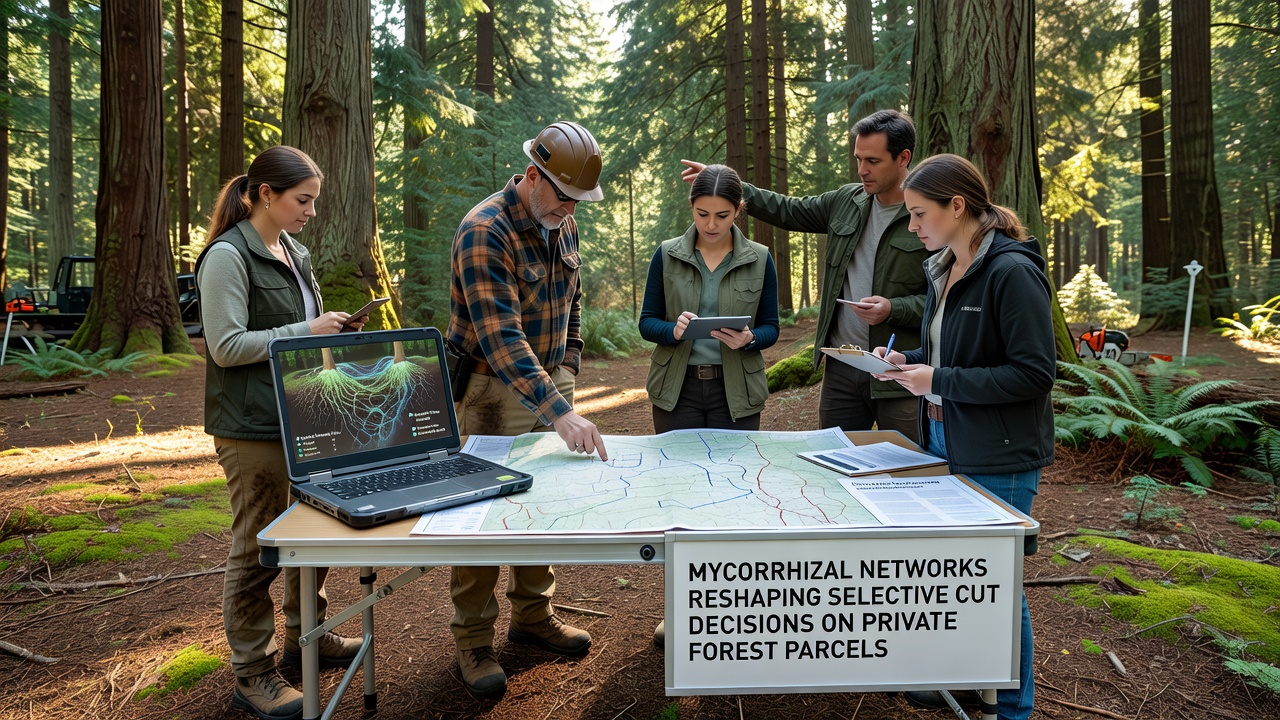
Equipment choices also matter because heavy machinery can sever hyphal strands when skidding trails cross high-density network areas. Operators now route trails along existing gaps or low-connectivity zones whenever topography allows, and several regional cooperatives have begun sharing LiDAR-derived soil moisture maps that correlate with fungal activity. These maps help crews avoid compacting soils that support the most active networks during wet periods.
Regional Examples and Ongoing Research
In the Pacific Northwest, private landowners participating in cost-share programs with Natural Resources Canada have tested variable retention cuts that leave small mycorrhizal “islands” of three to five trees. Early results show these islands accelerate recolonization of harvested ground by both fungi and desirable seedlings. Meanwhile, researchers at several U.S. land-grant universities continue to refine models that predict how different harvest intensities affect network integrity over 20-year rotations. Their findings indicate that single-tree selection maintains connectivity better than group selection in most soil types, although group selection can still work when groups are spaced to avoid isolating large portions of the stand.
Private parcel owners in Australia’s wet eucalypt forests have adopted similar principles, using government-supported extension materials that link mycorrhizal mapping to selective harvest planning. Although species and climate differ, the underlying mechanism—resource sharing through fungal partners—remains consistent across continents.
Practical Steps for Landowners and Managers
Landowners interested in incorporating network data typically start with a baseline soil assessment that identifies dominant fungal partners and their distribution. Next, they overlay this information on conventional cruise maps to adjust which trees receive paint. Some contract with consultants who use portable DNA kits for rapid field checks, while others rely on visual indicators such as abundant mushroom fruiting bodies near certain stems. Training programs offered through state forestry offices now include modules on these techniques, and participation numbers have risen steadily since 2024.
Cost remains a consideration because additional sampling adds expense, yet many owners recover that investment through improved residual growth and reduced regeneration costs. Insurance providers and lending institutions have begun asking for network-aware harvest plans when parcels serve as collateral, further encouraging adoption.
Conclusion
Mycorrhizal networks have moved from a research curiosity to a practical factor in selective cut planning on private forest parcels. As more owners integrate soil biology data with traditional silvicultural practices, harvest layouts continue to evolve toward configurations that preserve underground connectivity while still meeting economic objectives. Ongoing measurements through 2026 and beyond will clarify long-term outcomes across different forest types and ownership sizes, giving managers clearer benchmarks for balancing timber removal with biological infrastructure.